

ALL INDUSTRIAL AUTOMATION helps manufacturers worldwide keep proven legacy automation systems running by sourcing genuine, obsolete and hard-to-find PLCs, industrial automation parts and discontinued control system components.
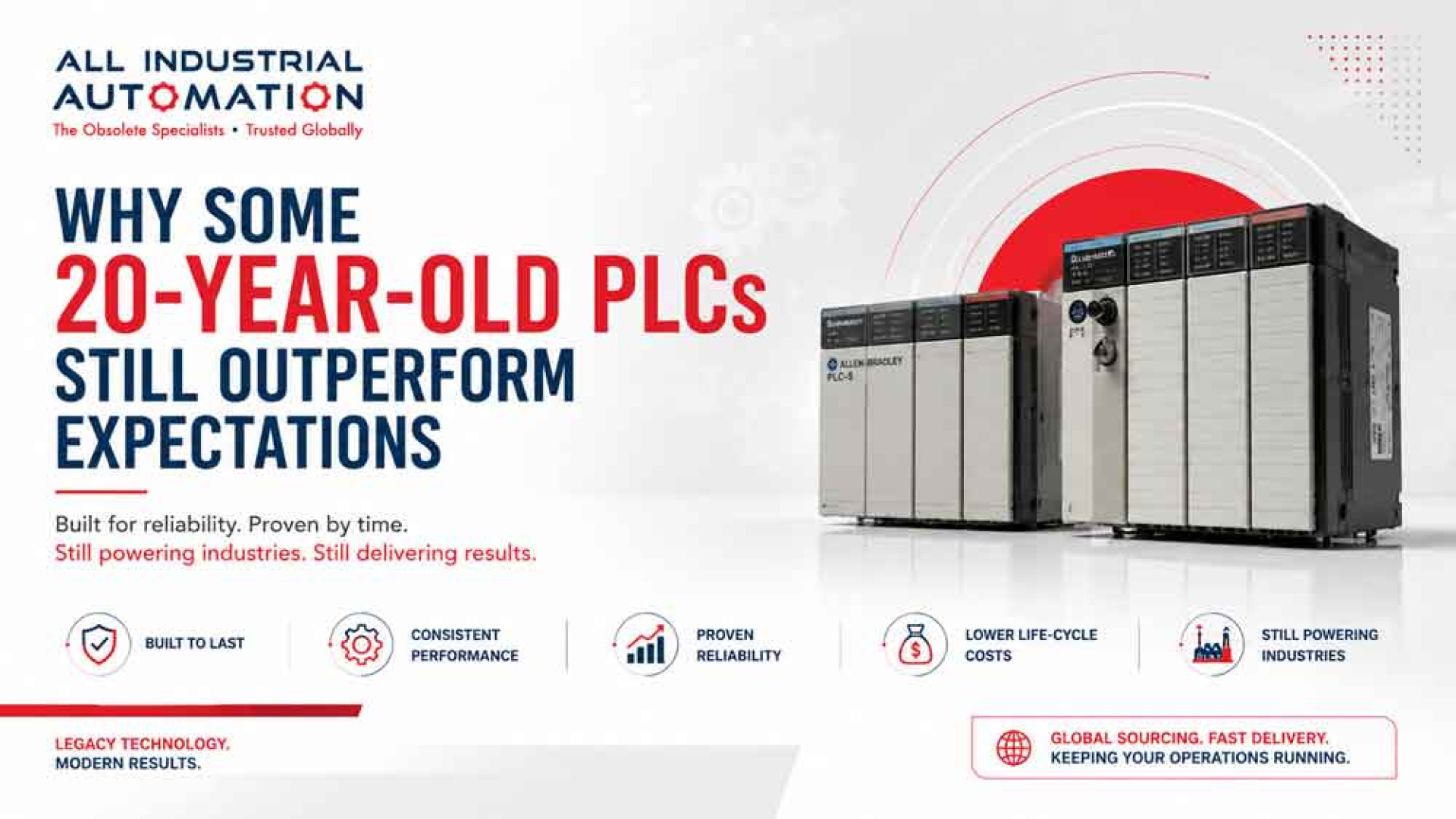
Why Some 20-Year-Old PLCs Still Outperform Expectations
In today's fast-moving technology landscape, equipment that has been operating for twenty years would normally be considered outdated. Yet across factories worldwide, many legacy PLCs continue controlling production lines every day with remarkable reliability.
While modern PLC platforms offer faster processors, greater connectivity and advanced diagnostics, many manufacturers continue relying on older systems because they simply continue doing what they were designed to do—operate reliably under demanding industrial conditions.
At ALL INDUSTRIAL AUTOMATION, we regularly support businesses searching for obsolete PLC parts, discontinued controllers and hard-to-find industrial automation components because these long-serving systems still remain critical to daily production.
Industrial PLCs Were Built for Long Service Life
Unlike consumer electronics, programmable logic controllers are designed for harsh industrial environments where reliability is more important than having the latest specifications.
Many PLCs installed during the late 1990s and early 2000s were engineered to operate continuously for decades inside manufacturing plants, water treatment facilities, food processing factories, power stations and oil & gas installations.
Their purpose was never to be replaced every few years. Instead, they were designed to deliver consistent performance under heat, vibration, dust and demanding production schedules.
Reliability Often Matters More Than New Features
When manufacturers evaluate automation systems, reliability usually carries greater importance than processing speed or cosmetic improvements.
A production line that consistently manufactures quality products without interruption often delivers greater business value than a newer platform requiring major engineering work to implement.
Many legacy PLCs continue performing well because they offer:
- Proven long-term reliability
- Stable control logic
- Well-understood maintenance procedures
- Established spare parts strategies
- Compatibility with existing machinery
- Predictable operational behaviour
For many facilities, these advantages outweigh the immediate benefits of upgrading to a completely new automation platform.
Older Doesn't Mean Less Capable
There is often a misconception that older PLCs are automatically inefficient or incapable of meeting modern manufacturing requirements.
In reality, many legacy control systems continue operating production equipment exactly as intended. If the manufacturing process has remained largely unchanged, the original controller may still provide everything required for reliable operation.
A PLC controlling conveyors, pumps, filling machines, packaging equipment or material handling systems does not necessarily become ineffective simply because newer models exist.
The Biggest Challenge Is Parts Availability
Performance is rarely the reason manufacturers replace legacy PLCs. More often, the challenge begins when the original manufacturer discontinues essential components.
CPUs, I/O modules, communication processors, power supplies and memory modules may eventually reach end-of-life, making them difficult to source through conventional distribution channels.
This is where experienced suppliers of obsolete PLC parts become increasingly important. Access to genuine and reliable replacement components allows manufacturers to continue operating proven automation systems while planning future modernization at the right time.
Modernization Doesn't Always Mean Replacement
Many successful manufacturers are modernizing around their existing PLC infrastructure instead of replacing everything simultaneously.
New HMIs, industrial networking equipment, remote monitoring systems, data collection platforms and predictive maintenance solutions can often be integrated alongside existing controllers.
This gradual approach reduces implementation risk, protects previous investments and allows manufacturers to modernize at a pace that suits their operations.
Maintain proven control systems that continue operating reliably.
Introduce modern HMIs, industrial IoT, analytics and monitoring without disrupting production.
Experienced Engineers Know These Systems Well
Another reason older PLCs continue outperforming expectations is the experience surrounding them.
Maintenance teams have spent years understanding how these systems behave, diagnosing faults, maintaining documentation and optimizing production programs.
This accumulated knowledge often represents a significant operational asset that cannot simply be replaced by installing newer hardware.
The Business Case for Keeping Legacy PLCs
Replacing an entire automation system is rarely limited to purchasing a new PLC.
A modernization project may involve new programming, electrical redesign, HMI redevelopment, field wiring modifications, operator training, commissioning, validation and planned production shutdowns.
For many manufacturers, extending the life of an existing system while maintaining access to hard-to-find PLC parts represents a more practical and cost-effective decision.
Legacy PLCs Continue Supporting Critical Industries
Many long-serving controllers remain operational across:
- Manufacturing
- Food & Beverage
- Oil & Gas
- Water & Wastewater
- Power Generation
- Mining
- Marine & Offshore
- Packaging & Logistics
Across these industries, operational continuity remains more important than replacing technology simply because it has reached a certain age.
Not Every Legacy PLC Should Be Replaced
There are situations where modernization is clearly the right decision, particularly when equipment becomes unsafe, unsupported or unable to meet changing production requirements.
However, replacing a controller purely because it has been operating for twenty years may not always deliver the best return on investment.
Manufacturers should evaluate each system based on reliability, parts availability, operational risk, maintenance history and future production requirements—not simply its age.
Reliable Spare Parts Keep Proven Systems Running
The continued success of many legacy automation systems depends on having access to dependable replacement components when failures occur.
Searching for obsolete PLC parts, discontinued industrial automation components, legacy Allen-Bradley PLCs, Siemens PLC spare parts or other hard-to-find equipment has become a routine part of maintaining mature production facilities around the world.
Working with an experienced global sourcing partner helps manufacturers reduce downtime, extend equipment life and maintain production continuity while planning future modernization on their own schedule.
Built to Last, Still Delivering Results
Technology continues to evolve, but dependable industrial engineering never goes out of style.
Many twenty-year-old PLCs continue exceeding expectations because they were built for reliability, carefully maintained and supported by experienced engineers who understand their value.
For countless manufacturers worldwide, these legacy controllers remain an essential part of modern production—and with the right support, they will likely continue serving industry for many years to come.
Supporting Legacy PLC Systems Worldwide
ALL INDUSTRIAL AUTOMATION supplies genuine, obsolete and hard-to-find PLCs, industrial automation spare parts and discontinued control system components from leading global manufacturers.
If you're searching for a discontinued PLC CPU, I/O module, power supply, communication module or other legacy automation component, our global sourcing team is ready to assist.
Submit Your Enquiry