

ALL INDUSTRIAL AUTOMATION supports manufacturers worldwide with genuine, obsolete and hard-to-find industrial automation parts that help reduce downtime, restore production and protect business continuity.
How Unplanned Downtime Affects More Than Just Production
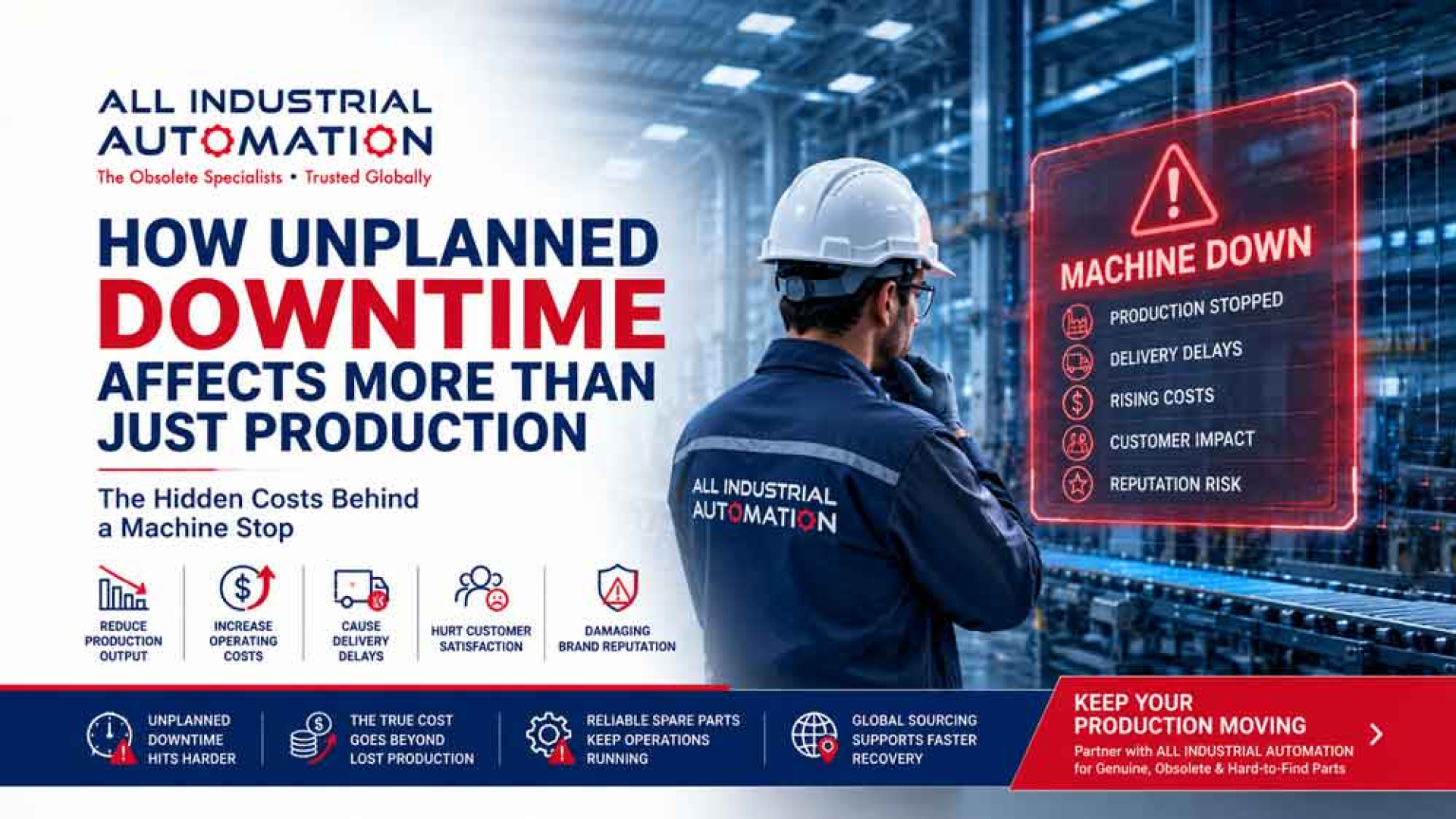
When a machine suddenly stops, the most visible problem is the interruption to production. Operators pause, output falls and maintenance teams begin searching for the cause. However, the real impact of unplanned downtime often reaches much further than the factory floor.
A single equipment failure can affect delivery schedules, operating costs, employee productivity, customer relationships and long-term business performance. When the failed component is an obsolete PLC, industrial drive, HMI panel, servo system or discontinued control module, the disruption can become even more serious if the correct replacement part is not readily available.
At ALL INDUSTRIAL AUTOMATION, we understand that an urgent request for an obsolete automation part is rarely just a parts enquiry. In many cases, it represents a production line waiting to restart, a customer order at risk or a maintenance team working against time.
Downtime Immediately Reduces Production Output
The first consequence of an unexpected machine failure is lost production. Depending on the equipment involved, one failed component may stop a single machine, an entire production cell or a complete manufacturing line.
During this period, planned output is not achieved, production targets are missed and work-in-progress may remain incomplete. In continuous manufacturing environments, even a short stoppage can create a backlog that takes several shifts or several days to recover.
A machine stoppage may immediately result in:
- Reduced production volume
- Missed shift targets
- Interrupted manufacturing processes
- Wasted raw materials or unfinished products
- Delayed packaging and dispatch
- Additional time required to recover lost output
For high-volume manufacturers, this lost output can quickly translate into significant financial pressure. The longer the production line remains down, the more difficult it becomes to recover the planned schedule.
The Financial Cost Goes Beyond Lost Production
The true cost of industrial downtime is rarely limited to the value of the products that were not manufactured. Unexpected equipment failure often creates several additional expenses at the same time.
Maintenance teams may need to work overtime, external technicians may need to be called in and urgent replacement components may require express international shipping. Production may also need to be rescheduled, creating additional labour and energy costs.
Urgent diagnostics, specialist support and emergency maintenance can cost significantly more than planned servicing.
Express sourcing and international delivery may be required when a critical automation part is unavailable locally.
Employees may need to work additional shifts to recover missed production and meet delayed orders.
Interrupted production may result in spoiled materials, rejected batches or inefficient restarting procedures.
This is why the financial effect of downtime often becomes much larger than the original repair cost. A failed PLC module or industrial power supply may be relatively small, but the business interruption it causes can be substantial.
Delivery Schedules Can Quickly Fall Behind
Manufacturing schedules are closely connected to customer delivery commitments. When production stops unexpectedly, dispatch dates may be missed, logistics arrangements may need to be changed and customers may receive their orders later than promised.
One delayed production line can also affect downstream processes. Packaging, quality inspection, warehousing and transport operations may all be disrupted, even if those departments are functioning normally.
For businesses operating with tight delivery windows, just-in-time inventory or contractual deadlines, a short period of production downtime can create consequences across the entire supply chain.
Customer Relationships May Be Affected
Customers may never see the failed machine, damaged drive or obsolete PLC module behind a delayed order. They only experience the final result: missed delivery dates, reduced availability or uncertainty.
Repeated delays can weaken customer confidence, especially when clients depend on reliable supply for their own operations. In highly competitive markets, customers may begin considering alternative suppliers if delivery performance becomes unpredictable.
Protecting production continuity is therefore also about protecting customer relationships. Fast access to industrial automation spare parts can help manufacturers restore operations sooner and reduce the risk of long-term reputational damage.
Employees Feel the Pressure of Unexpected Failures
Unplanned downtime also places significant pressure on maintenance teams, engineers, production supervisors and operators.
When a critical machine stops, technical teams may need to diagnose the fault quickly without complete documentation or immediate access to a replacement component. Production staff may remain idle, shifts may be reorganized and management may request frequent updates.
Over time, repeated emergency breakdowns can affect employee morale and increase workplace stress. Maintenance teams become focused on urgent recovery instead of planned improvements, preventive maintenance and long-term reliability.
One Failure Can Affect Several Connected Systems
Modern production environments contain many interconnected systems. A failed PLC, HMI, communication module, industrial computer or variable frequency drive may affect more than one piece of equipment.
For example, a communication failure may stop data exchange between machines. A failed controller may interrupt conveyors, packaging equipment and safety interlocks. A damaged power supply may prevent several modules within the same control panel from operating.
This is why accurate part identification and access to the correct PLC replacement parts or industrial automation components are so important. Installing an incorrect or incompatible part can extend downtime rather than resolve it.
Obsolete Parts Can Make Downtime Longer
Production recovery becomes more challenging when the failed component has been discontinued by the original manufacturer.
Older automation systems may depend on specific CPUs, I/O modules, communication cards, HMIs, servo drives or industrial power supplies that are no longer available through standard distribution channels. In such cases, maintenance teams may spend valuable time searching across multiple suppliers while the machine remains offline.
This creates high-intent searches for terms such as obsolete PLC parts supplier, discontinued automation parts, hard-to-find industrial spares and emergency industrial parts sourcing.
Working with an experienced global supplier can reduce delays by helping verify the part number, identify availability and arrange faster delivery of the required component.
Safety Risks Can Increase During Emergency Recovery
When production pressure is high, there may be a temptation to restart equipment quickly or use temporary workarounds. However, rushed decisions can introduce additional operational and safety risks.
Temporary bypasses, unsuitable replacement components and incomplete testing may create hazards for employees and machinery. Emergency repairs should always follow proper technical and safety procedures, even when downtime costs are increasing.
The safest recovery is one that restores the equipment using the correct part, proper installation practices and appropriate testing before production resumes.
Downtime Can Damage Equipment Further
An initial component failure may also cause secondary damage if the system is repeatedly restarted without identifying the underlying issue.
For example, a failing drive may place additional stress on a motor. An unstable power supply may affect several control modules. A communication fault may create repeated process interruptions that damage materials or mechanical equipment.
Quick diagnosis and access to reliable replacement parts can help prevent a relatively small failure from becoming a larger and more expensive repair.
Better Spare Parts Planning Reduces Business Risk
Manufacturers cannot prevent every unexpected equipment failure, but they can reduce the time required to respond.
A well-managed critical spare parts strategy identifies the automation components that could stop production if they fail. This may include legacy PLC CPUs, industrial power supplies, HMI panels, I/O modules, drives and communication cards.
Businesses can improve downtime preparedness by:
- Identifying production-critical automation components
- Recording complete manufacturer and part-number information
- Monitoring discontinued and end-of-life product ranges
- Maintaining selected spare parts onsite
- Building relationships with trusted global suppliers
- Keeping software backups and technical documentation available
- Planning phased upgrades before parts availability becomes critical
These steps help manufacturers respond more quickly when failures occur and reduce dependence on emergency decisions.
Fast Parts Availability Supports Faster Recovery
When a machine is already down, response time becomes critical. Every hour spent searching for the correct component can extend production losses and increase pressure across the business.
A dependable industrial automation parts supplier should be able to support accurate part identification, global sourcing, quality verification, secure packaging and reliable delivery.
This is particularly important for obsolete Siemens PLC parts, Allen-Bradley legacy components, discontinued Schneider modules, ABB drives, Mitsubishi controllers, Omron PLCs, Fanuc components and other mature automation platforms.
Downtime Is a Business Continuity Issue
Unplanned downtime should not be viewed only as a maintenance problem. It is a wider business continuity risk that can affect operations, finance, employees, customers and long-term competitiveness.
The strongest manufacturing operations are not necessarily those that never experience a failure. They are the ones prepared to respond quickly, safely and effectively when a failure occurs.
Access to dependable technical expertise, accurate equipment records and reliable automation spare parts can make the difference between a short interruption and a prolonged operational crisis.
Reduce Downtime with Reliable Global Parts Sourcing
ALL INDUSTRIAL AUTOMATION helps manufacturers worldwide source genuine, new, obsolete and hard-to-find industrial automation components from leading global brands.
Whether your production line requires a discontinued PLC module, HMI panel, industrial drive, servo component, power supply or communication module, our team can assist with urgent global sourcing requirements.
Submit Your Enquiry