

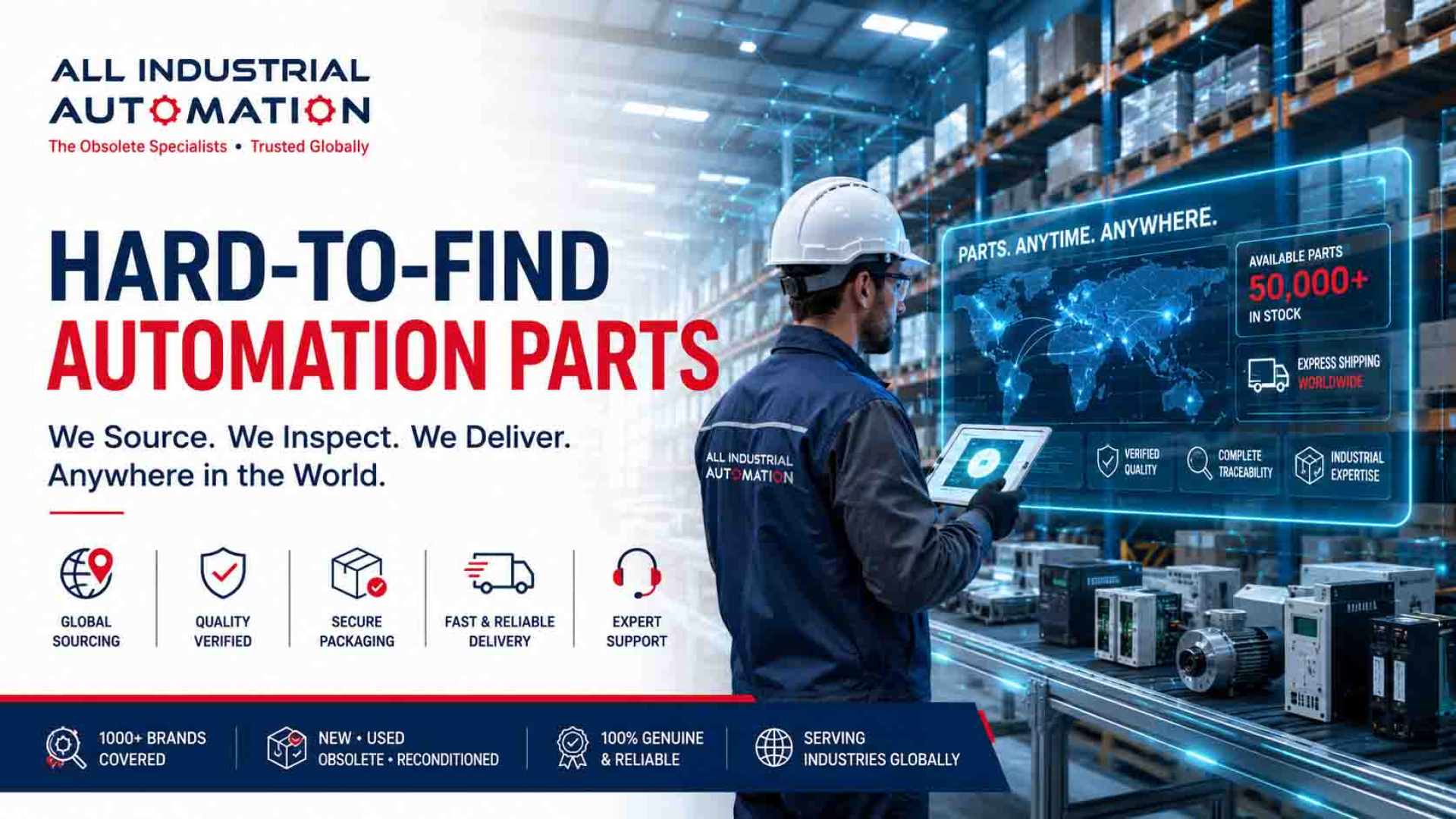
ALL INDUSTRIAL AUTOMATION supports manufacturers worldwide by sourcing genuine, obsolete and hard-to-find industrial automation parts that help keep proven legacy systems operational.
Why Legacy Automation Systems Are Still Driving Global Manufacturing
Across factories, processing plants and critical infrastructure worldwide, thousands of production lines continue to depend on legacy automation systems installed many years ago. These systems may no longer represent the newest generation of industrial technology, but they remain reliable, familiar and deeply integrated into everyday operations.
From legacy PLCs and industrial drives to HMIs, servo systems and control modules, older automation equipment continues to support manufacturing because it was built for long-term industrial use. For many businesses, maintaining a dependable system is more practical than replacing an entire production environment simply because newer technology is available.
At ALL INDUSTRIAL AUTOMATION, we regularly support companies searching for obsolete PLC parts, discontinued automation components, legacy control system spares and other hard-to-find replacement parts required to keep essential machinery running.
Industrial Equipment Is Built for Long-Term Operation
Industrial automation equipment is designed differently from consumer electronics. While personal devices may be replaced every few years, PLCs, drives, industrial computers and control systems are often expected to remain operational for 15, 20 or even 30 years.
Many legacy systems have already demonstrated decades of dependable performance. Maintenance engineers understand how they behave, operators are familiar with their controls, and technical teams have established procedures for maintaining them.
When an automation platform continues to perform its intended function safely and consistently, replacing it may not provide enough immediate value to justify the cost, disruption and operational risk involved.
A Complete Automation Upgrade Is More Than a Hardware Replacement
Modernizing an industrial control system involves much more than purchasing a new PLC or replacing an HMI. A full upgrade may require extensive engineering, programming, testing, documentation and operator training.
A major automation upgrade may involve:
- Production shutdowns during installation and commissioning
- PLC, HMI and SCADA software redevelopment
- Replacement of incompatible I/O and communication modules
- Changes to industrial networks and field wiring
- Operator and maintenance-team training
- System validation, testing and documentation
- Unexpected integration issues with existing machinery
For a continuously operating factory, even a short interruption can result in significant production losses. This is why many manufacturers continue maintaining their existing equipment while planning modernization gradually and strategically.
Legacy Automation Still Supports Critical Industries
Mature automation platforms remain active across nearly every major industrial sector. These systems continue controlling machinery, monitoring processes and supporting production in environments where stability is essential.
Legacy PLCs, drives and motion-control systems continue operating established production and packaging lines.
Proven control systems remain embedded within processing, monitoring and material-handling operations.
Older automation platforms continue supporting filling, processing, conveying and packaging equipment.
Legacy control hardware remains important in pumping, treatment, power-distribution and infrastructure systems.
Discontinued industrial components are often required to maintain specialized onboard and offshore equipment.
Validated production systems may remain in service because replacing them can require extensive requalification.
Modern Factories Often Combine Old and New Technologies
A modern factory does not necessarily contain only newly installed automation equipment. In reality, many facilities operate with a combination of established legacy machinery and newer digital technologies.
A long-serving PLC may continue controlling a machine while newer sensors, industrial gateways, monitoring software or data-analytics platforms provide improved operational visibility. A legacy production line may also be connected to modern SCADA systems, cloud dashboards, condition-monitoring tools or AI-supported maintenance platforms.
This gradual approach allows manufacturers to introduce useful technologies without discarding reliable equipment or committing to a complete factory-wide upgrade.
Access to Obsolete Automation Parts Remains Essential
The greatest challenge associated with aging industrial systems is often not performance, but parts availability. As manufacturers discontinue older product families, essential CPUs, I/O modules, communication cards, power supplies, drives and operator panels can become increasingly difficult to source.
Searches for obsolete industrial automation parts, discontinued PLC replacement parts, legacy PLC modules and hard-to-find automation spares often begin when a production line is already experiencing a failure. At that stage, access to the correct replacement component can determine whether operations resume quickly or remain interrupted for days or weeks.
Working with an experienced global industrial automation parts supplier can help businesses locate compatible components, verify part details and reduce the risks associated with sourcing discontinued equipment from unknown channels.
Why Manufacturers Continue Repairing Legacy Systems
Repairing or replacing an individual failed component can often restore a machine without requiring major changes to the surrounding control architecture.
For example, replacing a failed PLC CPU, industrial power supply, communication module, servo drive or HMI panel may allow an established system to continue operating with minimal disruption.
This approach is particularly valuable when:
- The existing machinery remains mechanically reliable
- The production process has already been optimized
- A replacement machine would require major capital investment
- The system is connected to specialized or custom-built equipment
- Production downtime must be kept to a minimum
- A full modernization project is planned for a later stage
Legacy Equipment Can Support More Sustainable Manufacturing
Extending the useful life of industrial equipment can also contribute to more sustainable manufacturing practices. Replacing a complete automation system generates electronic waste, consumes new raw materials and may require the disposal of components that are still functional.
Maintaining reliable equipment, repairing suitable components and replacing only what has failed can help businesses reduce unnecessary waste while maximizing the value of existing industrial assets.
This does not mean every old system should remain in operation indefinitely. Safety, reliability, cybersecurity, parts availability and operational risk must always be considered. However, age alone does not automatically make an automation system unsuitable.
Reliability Still Matters More Than Novelty
New automation technologies can deliver significant benefits, including better connectivity, improved data visibility, remote monitoring and advanced diagnostics. However, manufacturers must balance innovation with the need for stable and uninterrupted production.
In many industrial environments, a proven system with available spare parts and experienced maintenance support may offer greater immediate value than a complex upgrade carrying unknown integration risks.
This is why legacy automation remains deeply connected to the future of manufacturing. Rather than disappearing overnight, older systems are increasingly being maintained, monitored and modernized in carefully planned stages.
The Future Will Be a Balance of Legacy and Modern Automation
The future of global manufacturing is unlikely to involve replacing every older PLC, drive or control platform at once. Instead, it will be built on a practical combination of proven industrial equipment and carefully selected modern technologies.
Manufacturers will continue using reliable legacy systems while introducing new capabilities where they offer clear operational benefits. Strategic spare-parts planning, lifecycle management and phased modernization will remain essential to this balance.
With access to dependable obsolete automation parts and experienced global sourcing support, businesses can maintain production continuity while preparing for future upgrades on their own operational and financial timelines.
Supporting Legacy Automation Worldwide
ALL INDUSTRIAL AUTOMATION helps manufacturers source genuine, new, obsolete and hard-to-find industrial automation components from leading global brands.
Whether you require a discontinued PLC module, industrial drive, HMI panel, power supply, servo component or other critical automation spare, our team can assist with global sourcing and urgent requirements.
Submit Your Enquiry