

ALL INDUSTRIAL AUTOMATION supports manufacturers worldwide as they balance emerging industrial technologies with the continued need to maintain reliable legacy automation systems, obsolete PLCs and critical production equipment.
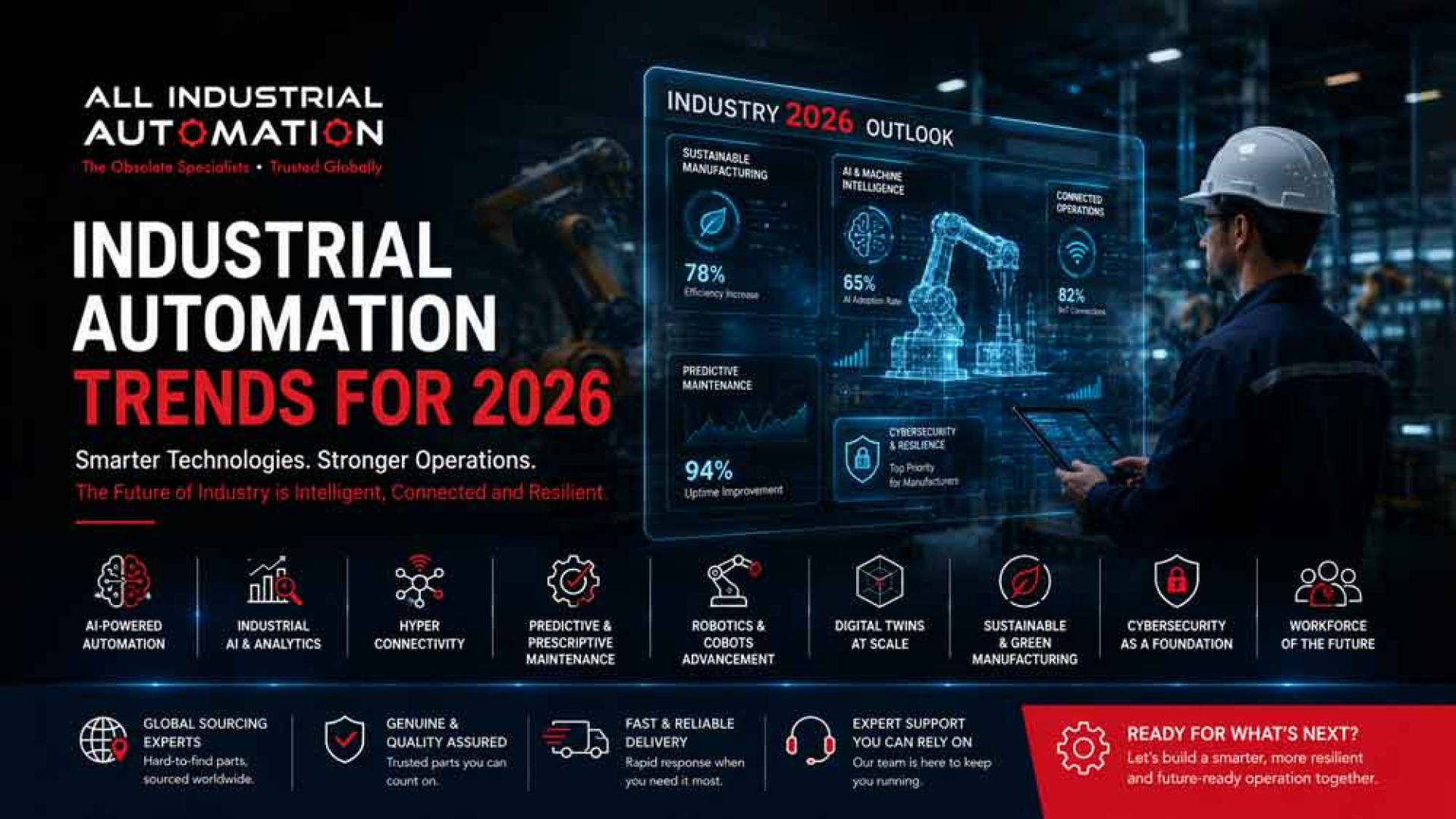
Industrial Automation Trends for 2026
Industrial automation in 2026 is becoming more intelligent, connected and adaptable. Manufacturers are investing in technologies that improve production visibility, reduce unplanned downtime, strengthen cybersecurity and support faster decision-making across industrial operations.
However, the future of manufacturing is not based only on replacing existing machinery with completely new systems. Many businesses are combining industrial AI, smart sensors, robotics, digital twins and predictive maintenance with established PLCs, drives, HMIs and legacy control platforms.
This balanced approach is shaping the most important industrial automation trends for 2026. Manufacturers want innovation, but they also need reliability, compatibility, operational resilience and a clear return on investment.
1. Industrial AI Is Moving Into Everyday Operations
Artificial intelligence is becoming a practical part of industrial automation rather than simply a future concept. Manufacturers are increasingly exploring AI-supported systems for equipment monitoring, production planning, visual inspection, process optimization and maintenance decision-making.
Unlike general-purpose artificial intelligence, industrial AI must work within demanding production environments where accuracy, reliability and safety are essential. The most valuable applications are therefore those that support experienced engineers and operators with better information rather than attempting to remove human oversight entirely.
Common industrial AI applications in 2026 include:
- Predicting possible equipment failures
- Detecting product defects through machine vision
- Optimizing production schedules and machine settings
- Identifying abnormal operating conditions
- Supporting technicians with maintenance information
- Improving energy and material efficiency
The emphasis is shifting from experimental AI projects toward focused applications that solve specific operational problems and deliver measurable improvements.
2. Predictive Maintenance Is Becoming More Accessible
Predictive maintenance remains one of the most important manufacturing technology trends in 2026. Instead of waiting for a machine to fail or servicing equipment only according to a fixed calendar, manufacturers can use operating data to identify changes that may indicate developing problems.
Sensors can monitor vibration, temperature, pressure, current, speed and other equipment conditions. Maintenance teams can then review trends and investigate unusual behaviour before it becomes a major production failure.
As monitoring tools become easier to deploy, predictive maintenance is no longer limited to newly constructed smart factories. Sensors and industrial gateways can often be added to established machinery, allowing businesses to improve visibility without immediately replacing the underlying control system.
3. Digital Twins Are Expanding Beyond Design
A digital twin is a virtual representation of a physical product, machine, production line or industrial process. In 2026, digital twins are increasingly being connected with real operational data and industrial AI to support decisions throughout the equipment lifecycle.
Manufacturers can use virtual models to test production changes, study machine behaviour, evaluate potential improvements and identify risks before making changes to physical equipment.
Control strategies and production sequences can be tested before installation or physical commissioning begins.
Manufacturers can compare different operating conditions without interrupting active production.
Real equipment data can be analysed against expected behaviour to identify developing performance issues.
Virtual environments can help teams understand systems and practise procedures without placing equipment at risk.
For many manufacturers, the real value of digital twin technology is the ability to make better decisions before committing time, materials and capital to physical changes.
4. Smart Factories Are Becoming More Connected
The connected factory remains a central theme in Industry 4.0 and smart manufacturing. PLCs, industrial robots, drives, HMIs, sensors, warehouse systems and enterprise software are increasingly expected to exchange useful operational information.
This growing connectivity allows production teams to view machine status, output, quality, energy use and maintenance requirements more clearly. It can also improve coordination between manufacturing, maintenance, procurement and management.
However, successful connectivity is not simply about collecting as much data as possible. Manufacturers need accurate, structured and relevant information that can support real decisions. Poor-quality data, incompatible equipment and disconnected systems remain significant barriers to effective digital transformation.
5. Edge Computing Is Supporting Faster Industrial Decisions
As factories generate more data, manufacturers need efficient ways to process information close to the machines creating it. This is increasing interest in industrial edge computing.
Edge devices can process selected data within the factory rather than sending every signal to a remote cloud platform. This can support faster response times, reduce unnecessary network traffic and allow important functions to continue even when external connectivity is limited.
In many facilities, the future will involve a combination of edge and cloud technologies. Time-sensitive operational decisions can be handled locally, while cloud platforms support larger-scale analytics, reporting and coordination across multiple sites.
6. Robotics Are Becoming More Flexible and Collaborative
Industrial robots have supported manufacturing for decades, but robotics in 2026 is becoming more adaptable. Newer systems combine advanced sensors, machine vision, improved safety functions and AI-supported decision-making.
Collaborative robots, commonly known as cobots, continue to attract interest for applications where people and robots work within the same operational environment. Autonomous mobile robots and automated guided vehicles are also becoming more common in warehouses, factories and internal logistics operations.
Growing robotics applications include:
- Material movement and intralogistics
- Machine loading and unloading
- Packaging and palletizing
- Visual quality inspection
- Hazardous or repetitive tasks
- Facility monitoring and industrial inspection
The strongest robotics projects are those built around a clear operational requirement rather than technology adoption for its own sake.
7. Machine Vision Is Expanding Across Manufacturing
Industrial machine vision is becoming more capable through improved cameras, processing systems and artificial intelligence. Vision systems can inspect products, verify assembly, read markings, track materials and identify possible defects at production speed.
Traditional machine vision is highly effective for consistent, rule-based inspection tasks. AI-supported vision can extend these capabilities to products and defects that are more difficult to define using fixed rules.
Manufacturers are increasingly combining both approaches, using established inspection methods where possible and introducing AI where it provides a clear advantage.
8. Industrial Cybersecurity Is Becoming a Core Requirement
As industrial environments become more connected, industrial cybersecurity is becoming a fundamental part of automation planning.
Legacy control systems were often designed for isolated networks and may not include the security functions expected in modern connected environments. Connecting these systems without appropriate protection can introduce operational risks.
Manufacturers are therefore placing greater emphasis on network segmentation, access control, asset visibility, secure remote access, software updates, backup procedures and incident-response planning.
9. Software-Defined and Open Automation Are Gaining Attention
Traditional automation platforms often connect software closely to specific hardware. In 2026, manufacturers are showing increased interest in more flexible, software-defined and interoperable automation architectures.
The goal is to make industrial applications easier to update, integrate and move between compatible systems. Greater openness may also reduce dependence on a single platform and make future modernization projects more manageable.
However, manufacturing environments require long-term reliability. Adoption is therefore likely to be gradual, with companies carefully evaluating performance, safety, support and lifecycle requirements before changing critical control architectures.
10. Sustainable Manufacturing Is Influencing Automation Decisions
Sustainability is increasingly connected to industrial automation strategy. Manufacturers are using monitoring and control technologies to understand energy consumption, material waste, equipment efficiency and process performance.
Smarter automation can help reduce unnecessary resource use, but sustainable manufacturing is not limited to installing new equipment. Extending the life of reliable machinery, repairing suitable components and replacing only what is necessary can also reduce electronic waste and protect existing investments.
This is especially relevant for businesses operating mature automation systems. A well-maintained legacy PLC or drive may continue supporting production effectively while newer monitoring technologies are added around it.
11. Legacy Systems Are Being Modernized Rather Than Immediately Replaced
One of the most practical industrial automation trends for 2026 is the continued integration of established equipment with modern digital technologies.
Many manufacturers cannot justify the cost, downtime and operational risk of replacing complete production systems. Instead, they are introducing industrial gateways, modern HMIs, data collection systems, smart sensors and monitoring platforms while retaining reliable legacy controllers and machinery.
This phased approach allows manufacturers to improve visibility and capability while protecting earlier capital investments. It also creates continued demand for obsolete PLC parts, discontinued control modules, industrial drives, HMIs and other hard-to-find automation spares.
Access to reliable replacement components remains essential because digital transformation cannot succeed if the underlying production equipment cannot be kept operational.
12. Supply Chain Resilience Remains an Automation Priority
Industrial supply chains have experienced repeated disruption in recent years. As a result, manufacturers are paying closer attention to automation component availability, long lead times and dependence on individual suppliers.
Businesses are reviewing their critical spare parts strategies, identifying vulnerable automation components and establishing relationships with global industrial parts suppliers before an emergency occurs.
This is particularly important for discontinued equipment, where waiting until a failure occurs can result in extended production downtime.
- Identify production-critical PLCs, drives and control modules
- Record accurate manufacturer and part-number details
- Monitor product discontinuation and end-of-life notices
- Maintain selected automation spares onsite
- Create software backups and preserve technical documentation
- Work with experienced global sourcing partners
13. Workforce Skills Are Evolving with Automation
The factory workforce of 2026 needs a combination of traditional engineering knowledge and modern digital skills.
Maintenance technicians increasingly work with connected sensors, industrial networks, analytics platforms and cybersecurity procedures alongside PLCs, drives, motors and control panels.
AI and robotics are therefore changing industrial roles rather than simply eliminating them. Human judgement remains essential for diagnosing unusual failures, understanding production priorities, managing safety and making decisions where operational context matters.
Manufacturers that invest in technical training and knowledge transfer will be better positioned to benefit from new automation technologies while continuing to support existing systems.
14. Automation Investments Are Becoming More Outcome-Focused
Manufacturers are becoming more selective about automation projects. Instead of adopting technology only because it is new, businesses are asking how it will reduce downtime, improve quality, lower operating costs or increase production flexibility.
This outcome-focused approach is especially important when integrating AI, robotics, digital twins and connected technologies into established industrial environments.
A successful automation project must consider integration complexity, workforce capability, cybersecurity, lifecycle support and compatibility with existing machinery.
What These Trends Mean for Manufacturers
The industrial automation landscape in 2026 is defined by gradual, practical transformation. Smart factories are becoming more intelligent, but most manufacturers are not starting with completely new infrastructure.
The more common strategy is to connect, monitor and enhance existing operations while modernizing selected areas where the business value is clear.
Manufacturers preparing for the future should focus on:
- Building accurate visibility of existing automation assets
- Improving industrial network and cybersecurity foundations
- Using AI for clearly defined operational challenges
- Introducing predictive maintenance where suitable data is available
- Evaluating robotics based on real process requirements
- Maintaining critical spare parts for legacy equipment
- Planning modernization in manageable and measurable stages
The Future of Automation Will Combine Innovation and Reliability
The defining industrial automation trend of 2026 is not any single technology. It is the growing ability to combine intelligent software, connected systems and advanced robotics with proven industrial equipment.
Factories still depend on reliability, maintainability and production continuity. AI, digital twins and smart sensors can strengthen those priorities, but they do not remove the need for dependable PLCs, drives, HMIs, power supplies and industrial control components.
The manufacturers best positioned for the future will be those that adopt new technologies carefully while protecting the systems that already keep their operations running.
Supporting the Systems Behind Modern Manufacturing
ALL INDUSTRIAL AUTOMATION supports manufacturers worldwide with genuine, new, obsolete and hard-to-find industrial automation components from leading global brands.
Whether you are maintaining an established production line, planning a phased modernization project or urgently searching for a discontinued PLC, drive, HMI, power supply or control module, our global sourcing team can assist.
Submit Your Enquiry